PRIORITY STANDARDS
The Tin Code includes 72 ESG standards across 10 Principles. From these, ITA identified 10 Priority Standards that all participating companies are expected to fully conform with.
While performance may vary across the wider Tin Code standards, these Priority Standards represent a consistent minimum requirement. All participating companies are expected to achieve a “Conforming” rating.
They were approved by the ITA Board for their critical role in delivering timely, measurable sustainability outcomes across the tin supply chain.
The Priority Standards apply across different areas of the tin supply chain. Some being relevant to explorers and miners, and others to smelters of primary and secondary materials. The number of applicable standards will depend on each company’s activities and operational circumstances.
- 1 1.3 Legal compliance
- 2 2.8 Tailings management
- 3 2.11 Banned substances
- 4 2.13 Protected areas
- 5 2.14 Closure and reclamation
- 6 3.2 Safe working practices
- 7 4.4 Forced labour
- 8 4.5 Child labour – worst forms
- 9 7.2 Use of private or state security personnel
- 10 7.3 Responsible sourcing
View the wording of the Priority Standards
Full List of Principles and Standards
ITA MEMBER PERFORMANCE
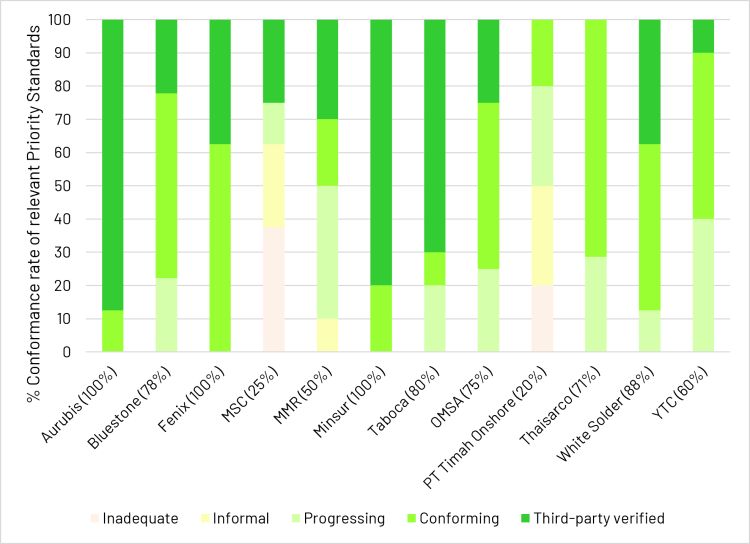
Member performance against the Priority Standards is assessed through the Tin Code validation process. Performance information is periodically updated to reflect the latest available assessment outcomes.
As shown in the accompanying performance graph, some members are already in full conformance, have already achieved full Priority Standards conformance, while others are at the earlier stages and progressing through improvement actions to address identified gaps.
All members are expected to achieve conformance within one or three years, depending on the complexity of the standard, identified gaps, and the circumstances, with a deadline of December 2025. Note that some Tin Code reports use non-calendar reporting years.
Supporting progress towards conformance
Where gaps are identified, ITA supports companies through:
- requiring improvement plans that set out actions to address identified gaps;
- providing guidance and learning opportunities;
- engaging with companies on challenges and progress; and
- monitoring progress through the Tin Code validation process.
Companies are encouraged to engage with ITA throughout the improvement process to discuss challenges, seek guidance and access available support.